

Where the money actually goes on a $100 pledge
The full arithmetic, with nothing hidden: what the backer pays, what we take, what the card network takes, and what lands in the business account.
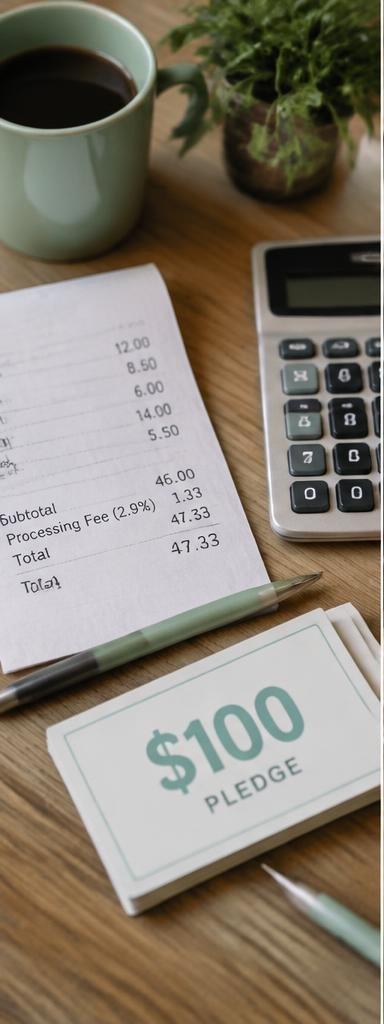
The full arithmetic, with nothing hidden: what the backer pays, what we take, what the card network takes, and what lands in the business account.
This guide is for an owner or backer who wants to understand the path from a pledge amount to the business's usable proceeds. The objective is to budget from net proceeds rather than the headline total and understand which charges belong to Pledzy versus payment processing. That requires more than a persuasive headline: the plan should be understandable, costed, and usable by the people responsible for carrying it out.
The guidance below separates the decision from the promotion. It explains what to prepare, how to test the plan, what can go wrong, and what to do next. Examples are illustrative unless they describe Pledzy's published fees or workflow.
Quick answer: The backer pays exactly $100
No added fee at checkout, no optional tip on top. The amount on the tier is the amount charged.
Quick answer: The deductions come off the business side
Pledzy takes 5% — 3% for verified nonprofits — and card processing of 2.9% plus 30¢ goes to the payment provider, not to us. The business receives about $91.80, or $93.80 at the nonprofit rate.
Quick answer: And nothing else
No listing fee, no monthly charge, no fee for a campaign that never launches or never raises. If you do not raise, we do not earn.
Follow one pledge from start to finish
This guide is for an owner or backer who wants to understand the path from a pledge amount to the business's usable proceeds. The objective is to budget from net proceeds rather than the headline total and understand which charges belong to Pledzy versus payment processing. That requires more than a persuasive headline: the plan should be understandable, costed, and usable by the people responsible for carrying it out.
A useful way to test the idea is to ask what a careful reader could verify without already knowing the owner. The answer should come from the project, the numbers, the images, and the terms—not from urgency alone. For example, a $100 pledge creates a platform fee, a percentage processing charge, and a fixed processing charge before reward costs are considered.
Why pledge size changes the effective cost
Move in sequence and keep a written record of each decision. A sequence prevents one attractive part of the campaign—usually the headline or reward—from getting ahead of the budget and operating reality.
- 1
Step 1: Start with gross expected pledges
Complete this before moving on. Record the person responsible, the evidence used, and any assumption that still needs confirmation. If the answer changes the budget, timeline, or reward promise, update those connected parts at the same time.
- 2
Step 2: Calculate the platform charge at the applicable rate
Complete this before moving on. Record the person responsible, the evidence used, and any assumption that still needs confirmation. If the answer changes the budget, timeline, or reward promise, update those connected parts at the same time.
- 3
Step 3: Calculate percentage and fixed processing for each expected pledge
Complete this before moving on. Record the person responsible, the evidence used, and any assumption that still needs confirmation. If the answer changes the budget, timeline, or reward promise, update those connected parts at the same time.
- 4
Step 4: Subtract reward and fulfillment costs
Complete this before moving on. Record the person responsible, the evidence used, and any assumption that still needs confirmation. If the answer changes the budget, timeline, or reward promise, update those connected parts at the same time.
- 5
Step 5: Set the public goal from the net project need
Complete this before moving on. Record the person responsible, the evidence used, and any assumption that still needs confirmation. If the answer changes the budget, timeline, or reward promise, update those connected parts at the same time.
Build a campaign-level net proceeds model
Consider this practical scenario: a $100 pledge creates a platform fee, a percentage processing charge, and a fixed processing charge before reward costs are considered. The point is not to copy the numbers or offer. It is to show how the promise, evidence, costs, audience, and delivery plan should agree with one another.
A worked example should make tradeoffs visible. If one line changes, revisit the connected goal, schedule, and communication rather than allowing the public page and operating plan to drift apart.
| Part of the plan | What it should show |
|---|---|
| Backer amount | $100.00 |
| Standard-business platform fee | 5% |
| Illustrative processing | 2.9% + $0.30 |
| Estimated business proceeds before reward cost | $91.80 |
Document the decision before you publish
Create a one-page working brief that states the audience, the intended outcome, the evidence, the main constraint, and the person responsible for the next action. For this topic, that means writing for an owner or backer who wants to understand the path from a pledge amount to the business's usable proceeds and keeping the central outcome visible: budget from net proceeds rather than the headline total and understand which charges belong to Pledzy versus payment processing.
The brief is not campaign copy. It is the record behind the copy. Attach quotes, calculations, policies, photographs, delivery assumptions, or professional advice where they apply. Mark what is confirmed, what is estimated, and the date each estimate was checked. When a fact changes, update the working brief first and then every public promise that depends on it.
A second person should be able to use the brief to find the source of a number and understand why a deadline or reward term was chosen. If they cannot, the public explanation is likely relying too heavily on the owner's memory. This small discipline also makes later updates easier because the original assumptions are still visible.
What the fee does and does not cover
Most weak campaigns are not missing enthusiasm. They are missing one operational connection: a cost does not appear in the goal, a reward has no capacity limit, a deadline ignores review or fulfillment, or a trust signal is described as a guarantee.
- Treating the headline total as spendable cash.
- Forgetting the fixed charge on many small pledges.
- Leaving reward costs outside the campaign budget.
- Describing payment processing as Pledzy revenue.
Questions to answer before setting a goal
Use this list as a final pause before publishing, pledging, or beginning fulfillment. A checked box should represent a real decision or piece of evidence, not an intention to solve it later.
- ✓The organization type and fee rate are correct.
- ✓Average pledge size has a reasonable assumption.
- ✓Reward costs include labor and delivery.
- ✓The goal includes an appropriate fee allowance.
- ✓Backer-facing language remains simple and transparent.
Measure the result and close the loop
Decide what a responsible result looks like before activity begins. The measure should connect to the promised outcome rather than vanity metrics. Visits and shares can explain attention, but the more important evidence is whether people understood the offer, whether commitments became collected payments, whether the planned work moved forward, and whether rewards were delivered as described.
Keep a short decision log during the campaign or review process. Record questions people ask repeatedly, assumptions that proved wrong, operational changes, and the reasons behind any delay. These notes become the raw material for honest updates and make the next campaign easier to plan.
Close with proof appropriate to the promise: a receipt or completed milestone where it is safe to share, a photograph of the finished work, a fulfillment update, or a clear explanation of what changed. Do not publish private backer, banking, tax, insurance, employee, or security information in the name of transparency.
- ✓The success measure connects to the stated outcome.
- ✓Pledged and collected amounts are not treated as interchangeable.
- ✓Changes are recorded with dates and reasons.
- ✓Backers receive an update before a promised date passes.
- ✓The final proof protects private information.
The bottom line
The strongest next step is simple: Start with gross expected pledges. Then complete the checklist before making the promise public.
Pledzy can organize the page, review it before publication, and help the community find it. The owner remains responsible for the accuracy of the campaign and the delivery of its rewards.
Related articles

The case for keep-what-you-raise
All-or-nothing funding made sense for product launches. For a local business with a real bill to pay, it mostly just destroys money.
Read article
Before you pledge
A pledge is a trade, not a donation and not an investment. Here is exactly what you are agreeing to.
Read article